Not All Leaks Are the Same — But None Should Be Ignored
You walk out to your car and see a puddle underneath it.
Now the questions start:
- Is it serious?
- Can I still drive it?
- What color is it supposed to be?
- Does the size matter?
The truth is simple: the color of the fluid tells you a lot about what’s leaking. Some leaks are minor. Others can destroy an engine, transmission, or braking system quickly.
If you’re in Northglenn, Thornton, Broomfield, or the surrounding Denver metro area, here’s exactly what the color under your car likely means.
🟤 Brown or Black Fluid – Engine Oil
Most common leak.
If the fluid is dark brown or black and slick, it’s likely engine oil. Fresh oil is amber. Over time, it turns dark as it collects contaminants.
Common causes:
- Worn valve cover gasket
- Oil pan gasket leak
- Loose drain plug
- Failing oil filter housing
Is it safe to drive?
Maybe — but only short term. Low oil levels can cause severe engine damage fast. If you also smell burning oil, schedule service immediately.
🔴 Red or Pink Fluid – Transmission or Power Steering Fluid
Bright red or pink fluid usually means:
- Automatic transmission fluid (ATF)
- Power steering fluid
If it’s near the front middle of the vehicle, suspect transmission. If it’s closer to the front left or right, it may be power steering.
Is it safe to drive?
Not for long. Low transmission fluid can cause slipping, overheating, and full transmission failure. Low power steering fluid can damage the pump and make steering difficult. Both repairs get expensive quickly if ignored.
🟢 Green, 🟠 Orange, or 🟡 Yellow – Coolant (Antifreeze)
If the fluid is brightly colored and slightly sweet smelling, it’s likely coolant.
Coolant can be:
- Green
- Orange
- Yellow
- Pink (depending on manufacturer)
Common causes:
- Radiator leak
- Failing water pump
- Cracked hose
- Reservoir failure
Is it safe to drive?
No. Overheating can warp cylinder heads or destroy an engine. If your temperature gauge is climbing, shut the vehicle off.
🟡 Clear or Light Yellow – Brake Fluid
Brake fluid is usually clear to light yellow and feels slippery but thinner than oil. Leaks often show up near a wheel or under the driver’s side firewall.
Is it safe to drive?
Absolutely not.
Brake fluid leaks can lead to:
- Soft brake pedal
- Reduced stopping power
- Complete brake failure
This is one of the most urgent leaks.
💧Clear Water – Probably Nothing
If it’s clear, odorless, and appears after running the AC — it’s likely just condensation. That’s normal. No repair needed.
Where the Leak Is Located Matters
Color helps. Location confirms.
- Front center → Engine or transmission
- Near wheels → Brakes or coolant
- Rear center → Fuel or differential fluid
- Under passenger side → Often AC condensation
If you’re unsure, don’t guess. A quick inspection prevents major repairs.
How Big Is the Leak? (Size Matters More Than You Think)
When someone calls us about a leak, we ask a few simple questions:
- Is it on your driveway or in a parking lot?
- Does it show up overnight?
- How big is the puddle?
The size and rate of the leak tell us a lot. Here’s a simple way to think about it:
🟢 Golf Ball Size (1–2 inches)
Usually a minor seep.
This might be:
- A small gasket leak
- Light condensation
- Early-stage oil seepage
Not always urgent — but worth monitoring.
🟡 Apple Size (3–4 inches)
Now we’re paying attention.
This typically means:
- Active oil leak
- Coolant starting to escape
- Transmission pan seep
At this stage, repairs are usually still manageable.
Waiting too long can make it worse.
🔴 Dinner Plate Size (6+ inches)
This is an active leak.
If it develops overnight or within a few hours, it’s not something to ignore.
This can indicate:
- Significant gasket failure
- Cracked hose
- Failing transmission seal
- Brake system issue
Driving with a leak this size increases the risk of major damage.
⚠️ Larger Than a Dinner Plate or Dripping Constantly
That’s urgent.
If you see steady dripping or fluid actively pooling while the vehicle is running, the vehicle should be inspected as soon as possible.
Especially if:
- The temperature gauge rises
- Steering feels heavy
- The brake pedal feels soft
- Warning lights appear
Rate of Leak Matters Too
Size is only part of the story.
Ask yourself:
- Is it growing each day?
- Does it appear every time you park?
- Is it worse after driving?
A small leak that grows quickly can be more serious than a larger leak that stays consistent.
Why We Ask These Questions
When you call Motiveworks Auto in Northglenn, these are the exact comparisons we use.
Golf ball.
Apple.
Dinner plate.
It helps us:
- Gauge urgency
- Plan the right diagnostic approach
- Help you decide whether it’s safe to drive
Simple comparisons remove guesswork and panic.
When Should you get a leak checked?
Immediately if:
- The puddle is growing
- You smell burning
- Warning lights are on
- The temperature gauge is rising
- The brake pedal feels soft
Small leaks become big repairs fast.
Fluid Leak Diagnosis in Northglenn, CO
At Motiveworks Auto, we perform:
- Leak source tracing
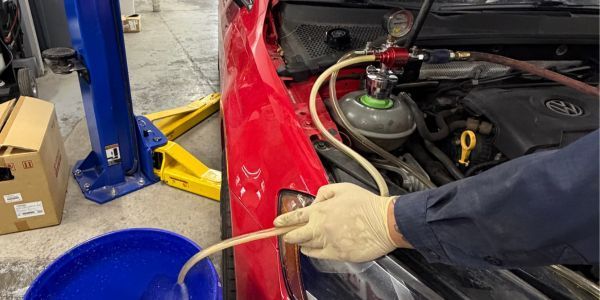
- UV dye testing
- Pressure testing
- Full digital inspections with photos
- Clear, no-pressure repair recommendations
If you’ve noticed fluid under your vehicle in Northglenn, Thornton, Broomfield, or the surrounding Denver metro area, don’t wait. A simple gasket today can prevent an engine or transmission tomorrow.
Schedule Your Inspection
Fluid leaks don’t fix themselves.
If your vehicle is leaking and you’re unsure what it is, schedule an inspection at Motiveworks Auto today.
We’ll identify the source, explain what it means, and give you a clear plan forward.
Because small problems should stay small.